Deploy the specialists
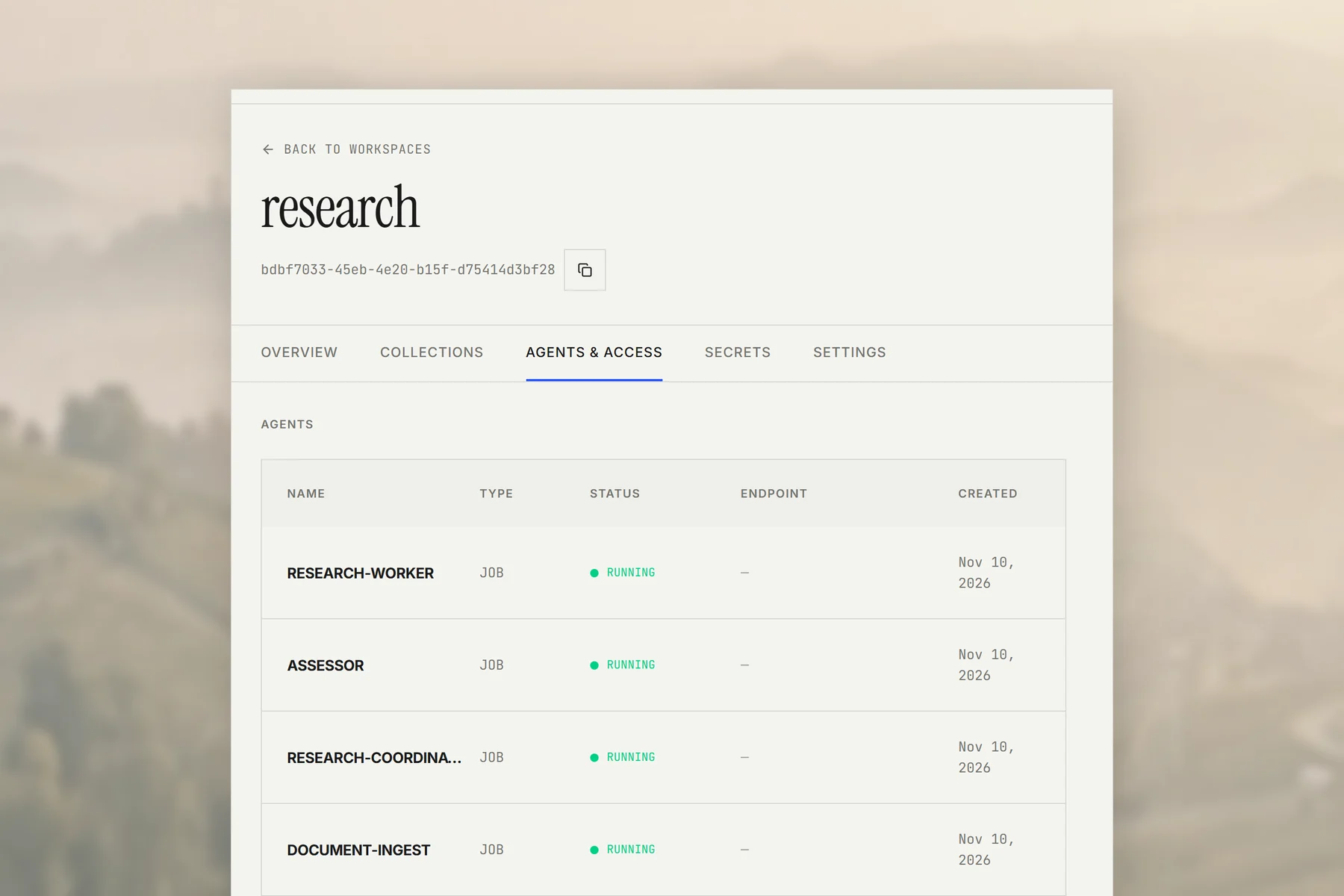
Create agents with narrow responsibilities and deploy them before the coordinator.
Build a coordinator that delegates to specialist workers. Pass payloads, inspect outcomes, and keep shared knowledge in collections.
How it fits together
Create agents with narrow responsibilities and deploy them before the coordinator.
Enable spawning on the parent and name its workers in the manifest.
Wait for worker outcomes, read results, and handle partial completion or refusals in your code.
Explicit relationships
A worker is an agent of either kind, with its own code, runtime, and execution settings. A task runs once and exits; a service receives the work as a request. A coordinator splits research or processing into units those agents understand.
Read the spawn contract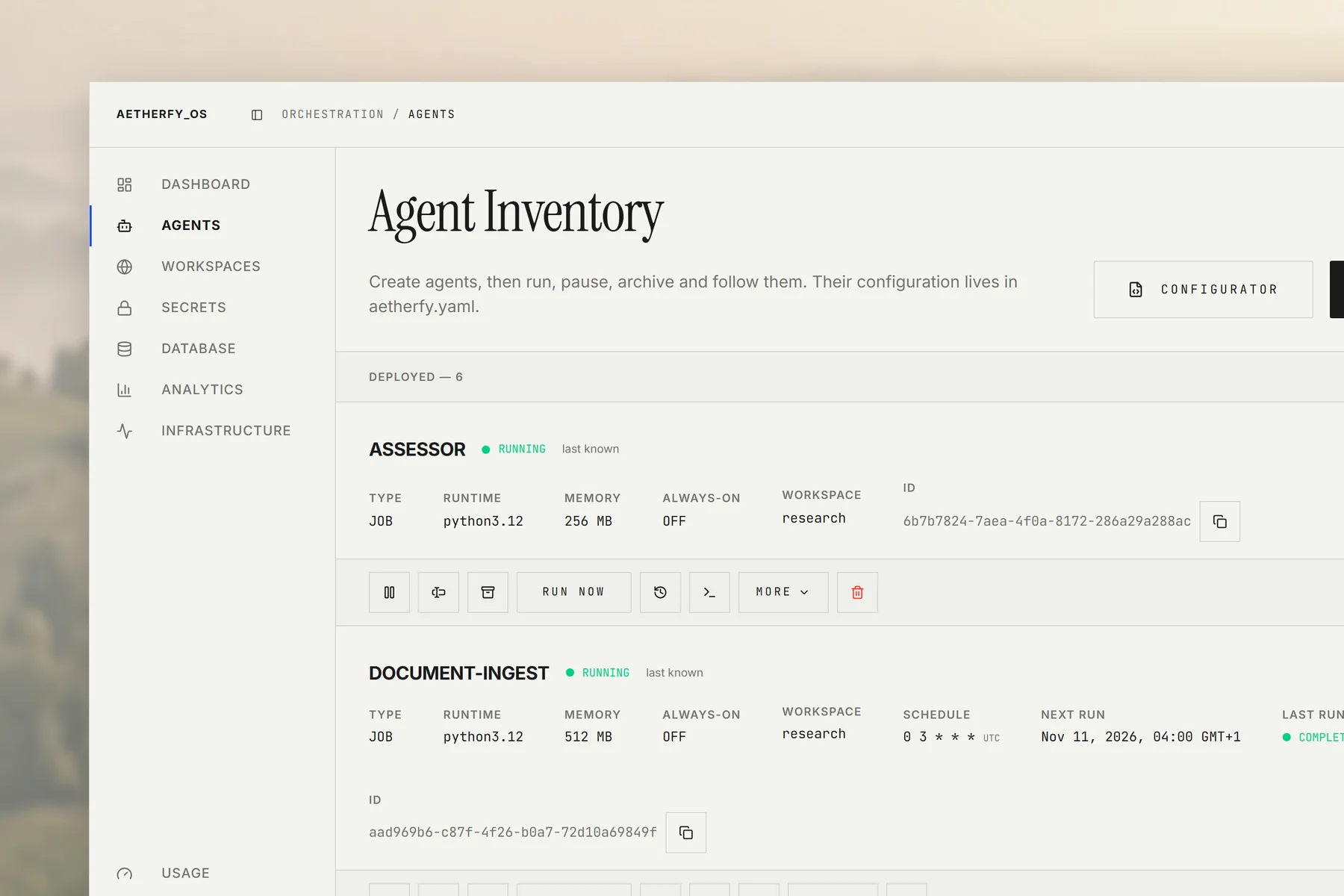
The parent enables spawning and declares its allowed workers. Workspace discovery helps related agents find one another; the spawn contract defines which calls are allowed. For a direct conversation, an agent calls a service at its URL, which every agent in the workspace receives as AETHERFY_AGENT_<NAME>_URL. Deploy workers before the parent that depends on them.
Inputs become outcomes
A spawn returns when its run is recorded. Your parent then waits, reads the resulting state, and consumes the worker’s output when the work has completed.
Build fan-out and aggregation, an independent assessor, or a coordinator that checks progress in a child’s logs. The SDK examples show these patterns in Python and Node, with model calls left to your application.
A coordinator and its workers can also talk while they run. A worker can report progress or ask its parent a question partway through, and the parent can send a running task new instructions. A task waiting for a message sleeps and isn’t billed for running time; the message wakes it. A service run waits awake, billed as the service’s uptime.
Explore complete worker patterns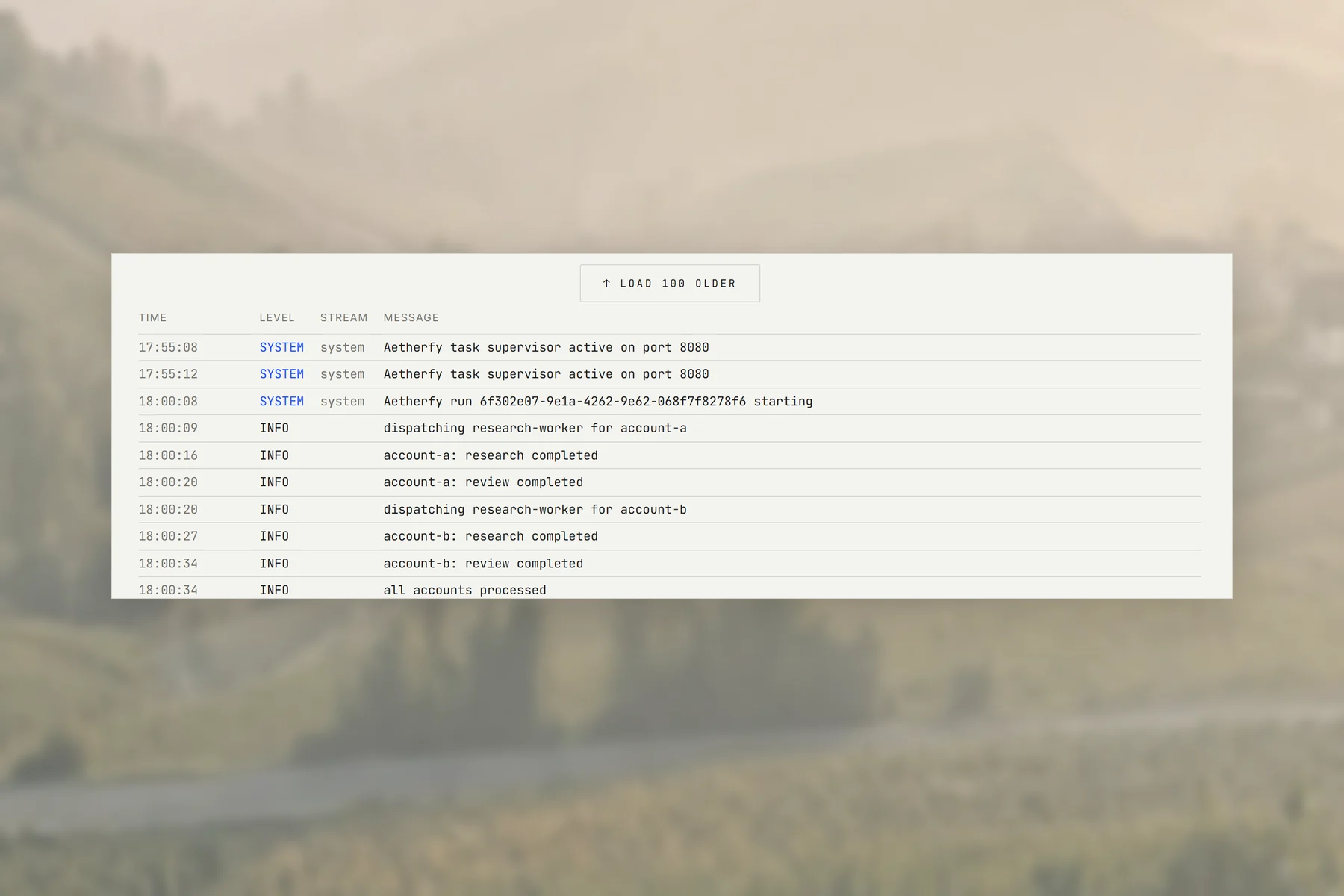
Bound the work
Task runs share your plan’s runs-at-once limit. A run passes its slot to the run it starts, and a parent waiting for a child lends it its slot, so a coordinator never blocks its own workers. A service run adds no machine, so it does not count toward that limit. Past the limit, task runs wait in the account’s line and start in order as slots free up; the line has its own bound on each plan, and a run past it is refused, so handle that refusal and avoid duplicate side effects. Any run, waiting or running, can be cancelled, with the runs it started. Free allows one agent and one run in flight, so a coordinator with workers needs a paid plan.
Separate workers make sense when work needs separate execution and inspection. When that isolation is unnecessary, parallel work inside the parent process can be a simpler choice. Keep long-lived shared state in storage rather than a worker’s process memory.
Understand task execution and its limitsafy status research-workerafy status assessorafy access research-workerafy list --jsonA concrete starting point
This is the parent manifest. Deploy research-worker and assessor first; each can be a task or a service. Their payloads, result format, and decision logic belong to your application.
Continue in the documentationruntime: python3.12type: jobentrypoint: main.pyspawn: enabled: true workers: - research-worker - assessorA clear division of work
Before you build
Agents can use collections in their workspace, and collections in other workspaces when granted access. Each agent’s access level determines which operations its key can perform.
Yes. A task run past your plan’s runs-at-once limit waits in the account’s line and starts in order as slots free up, with nothing billed while it waits. The line has its own bound on each plan; a run past it is refused, and your application decides when to try again. A service run never waits.
Not with workers. Free allows one agent and one run in flight, so a coordinator and its workers need Starter or above.
Your code chooses the models and libraries. Aetherfy provides execution, spawning, memory, and operational controls rather than imposing the reasoning framework.
One platform for the work ahead